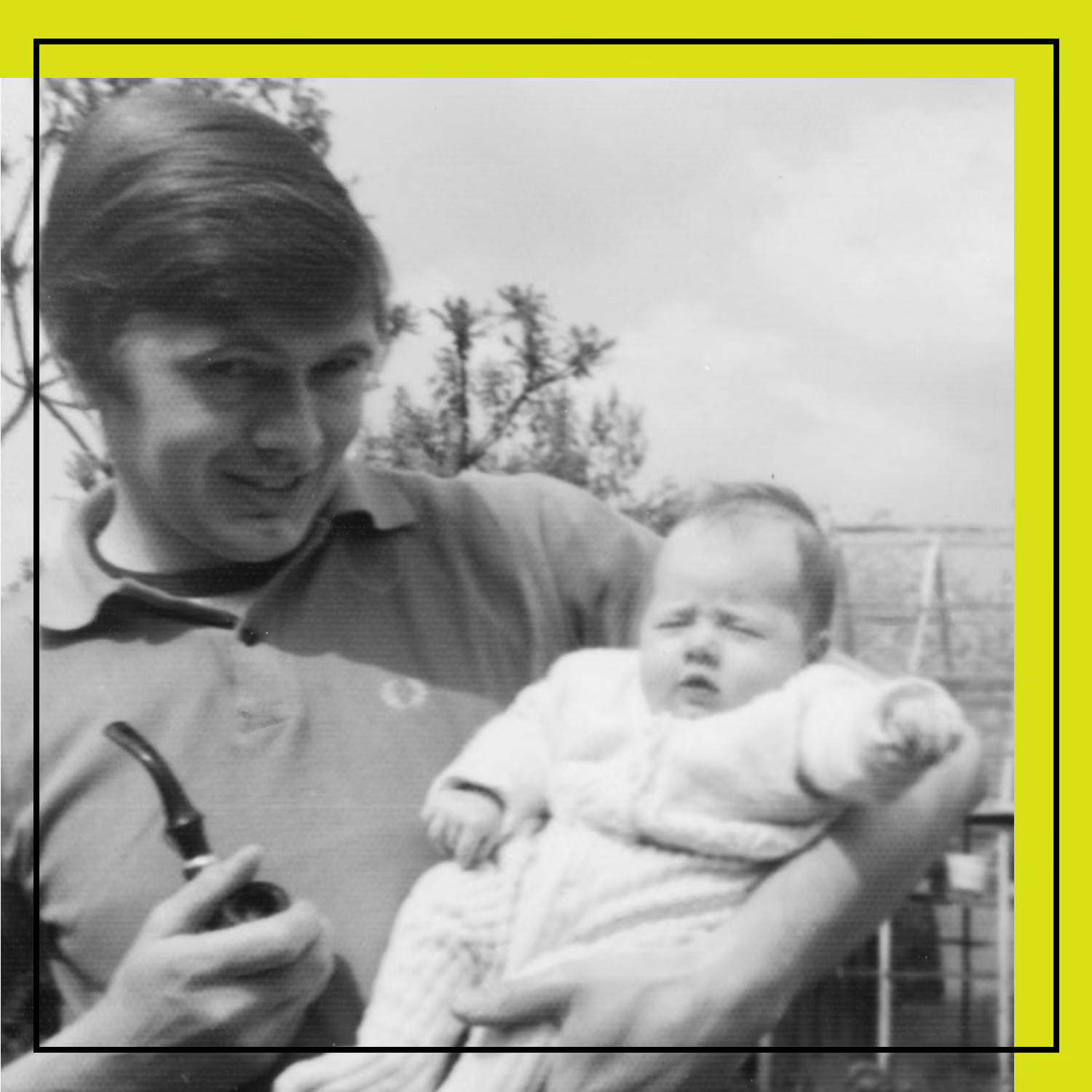
What I Learned From My Father's Undiagnosed Mental Illness|A young woman struggles with feelings of anxiety around inheriting her father's mental illness.|A father struggling with lifelong mental illness.|It takes daily acts of courage to heal the wounds inflicted by a mentally ill parent.
What I Learned From My Father's Undiagnosed Mental Illness|A young woman struggles with feelings of anxiety around inheriting her father's mental illness.|A father struggling with lifelong mental illness.|It takes daily acts of courage to heal the wounds inflicted by a mentally ill parent.
What I Learned From My Father's Undiagnosed Mental Illness
I grew up believing that mental illness was something that happened to other people.When I was a child, my mum would sometimes refer to my dad as “mental.” She’d choke the words through tears when my dad was in “one of his moods,” and she had to tell my siblings and me to stay out of his way.There was no telling what would trigger Dad’s “moods.” After an argument with my mum, he’d often remain silent for days. The tension in the house would manifest as a twisting in my stomach, a feeling of impending doom. By the time I was ten, his silences would begin for no reason and last for weeks. The effect was like a dark storm cloud settling over the whole house.
The more painful memories continue to taint my feelings of self-worth.
I Inherited My Dad's Mental Illness
Unsurprisingly, I grew up shy and introverted, believing that emotions and feelings were not acceptable. I turned to food for comfort, feeding my sadness, and became ensnared in a cycle of shame and self-loathing.In my mid-20s, after two years of falling ill with every cold and infection I could possibly catch, my body finally succumbed and I ended up in the emergency room with chest pains and palpitations. I described my symptoms to my doctor as a numbness, as though there was an invisible screen between me and the world. I pushed away the nagging thought that my mental health might be the root cause of my deteriorating physical health.At the same time, I was having panic attacks that would wake me in the night, my stomach held a perpetual knot and invisible hands constricting my throat. And those were just the physical symptoms. A relentless script of negative, catastrophizing thoughts plagued every minute of every day. The doctor diagnosed me with anxiety and depression.My biggest fear was turning into my dad, so I railed against any hint that I was like him, even at the expense of my own health. I worked hard to be the opposite of him. I funded myself through two degrees, started a career and was the responsible one in my circle of friends. An overnight stay in the hospital as they monitored my heart finally made me accept that I had to change.Despite my dad’s behavior, I’d search for his redeeming qualities. I found just two. When he wasn’t angry or nasty, he could be funny. We’d cry with laughter at the '80s sitcom Only Fools and Horses. He bought my favorite perfume for my eighteenth birthday, which was unusual. All previous birthday and Christmas gifts had been the result of a few extra banknotes with the usual housekeeping money, passed reluctantly to my mum, which she turned into presents.When I grasp for these memories, they crumble beneath the sense of loss I have from Dad’s emotional unavailability. The happier memories are barely tiny stars in the night sky of my life. They’re not enough to sustain a real father-daughter relationship.
My Dad Was Hurting, So He Hurt Us Too
The more painful memories continue to taint my feelings of self-worth. At 14 I’d been ecstatic about an upcoming Backstreet Boys concert, and how I’d finally see Nick, my favorite, in real life. My dad sneered and told me, “He wouldn’t look at you twice.” Dads are supposed to love you unconditionally, and when mine rejected me, I believed there had to be something wrong with me. I piled on extra weight as food became my only source of comfort.Despite the insults, I was desperate to find reasons to excuse Dad’s behavior, something that would disprove my suspicion that he didn’t love me. My mum told me that Dad’s dad had died of cancer when he was 13 and that he’d had a mental breakdown shortly thereafter. Dad’s family had called the doctor after he’d refused to leave his bed and had stopped the daily routine of washing and taking care of himself. Dad has always been scant with the details of that time, although he told my mum that he’d been close to his dad, and he’d vowed never to bond with his children.Dad’s mental breakdown had happened in 1950s Britain, when mental illness was something that was hidden away. In the early years, Mum had begged Dad to get help for his moods, but Dad denied there was anything wrong, and his illness remained untreated. It still does to this day.I grew up with the belief that Dad’s silence came from an absence of feeling. When anxiety took away my voice, I thought my silence meant I was like him. As I struggled with my diagnosis, I learned that silence isn’t the absence of feeling—it’s the very opposite.Dad’s flawed teenage logic was a way of protecting himself from pain, but it meant that no one was happy. In avoiding pain he’d become immune to love and joy. In denying me a father, he hadn’t saved me from hurt but created a gaping wound. As an adult, I realize that the payoff of love is grief and that when we love someone deeply, we understand that their loss will bring us pain.
I’d given my childhood trauma the perfect conditions it needed to morph into chronic anxiety.
I Decided to Break the Cycle
My dad was diagnosed with cancer, for the second time, in early 2020. Around the same time, a work colleague who I’d come to think of as my “work dad” died unexpectedly. It’s unsurprising that my anxiety flared up in response.Rather than worrying about my dad’s health, I imagined the freedom I might feel if he were to leave this earth for good. I felt intensely guilty and struggled with broken sleep as I fought with myself. Was I a bad person for feeling this way? But at the same time, how could I be sad about someone who was a father only in name?My spiral into anxiety and depression in my 20s had been a manifestation of suppressed and repressed feelings. My mum had always told me, “We don’t need him, we’ve got each other.” By denying my feelings then, I’d given my childhood trauma the perfect conditions it needed to morph into chronic anxiety.This time, instead of denying my grief and anxiety, I found the courage to face my feelings and started therapy. Talking helped me see that my mum had normalized Dad’s behavior and denied my feelings to avoid her own emotions. I now accept that it’s okay to say that I missed having a dad.I’ve only recently begun to accept that my mental health challenges are the result of emotional abuse and unresolved childhood trauma. I’m 36 years old now, and it takes daily acts of courage to heal. Every time I eat a healthy meal instead of overeating I’m choosing self-care over self-loathing. When anxiety strikes at work, I push through the fear, knowing that the judgmental voice is my dad’s. I’m constantly correcting old narratives and judgments that belong to my dad.I still struggle to make connections with others and to maintain close friendships, because I still believe I’m not worth getting to know. I’m taking tentative steps to allow others to see my vulnerability in an effort to build trust.My healing journey has taught me compassion for others going through similar struggles, yet I can’t forgive my dad. He made sure that when he suffered, his family also suffered. I can’t reconcile his undiagnosed mental illness with the emotional abuse he directed at his family.Although it’s painful to rake over old memories in therapy, I’m allowing myself to grieve for the dad I didn’t have, and I’m stronger for it. I’ve begun to shed the extra weight I’ve carried all my life and replace my negative coping mechanisms with exercise and an appreciation for all that my body has endured over the years.I understand now that I’ll never have a relationship with my dad. He’ll never take responsibility for his behavior, and after 60 years of denial, he’s not going to change. I no longer compare my mental illness with my dad’s. I’ve had the courage to face my pain and accept responsibility for my behavior and healing, while he’s built his protective walls so high that he can’t surmount them.I live with the understanding that my dad’s untreated mental illness means he will never be the dad I wanted or deserved. It’s a constant effort to show myself that I am lovable in spite of this.